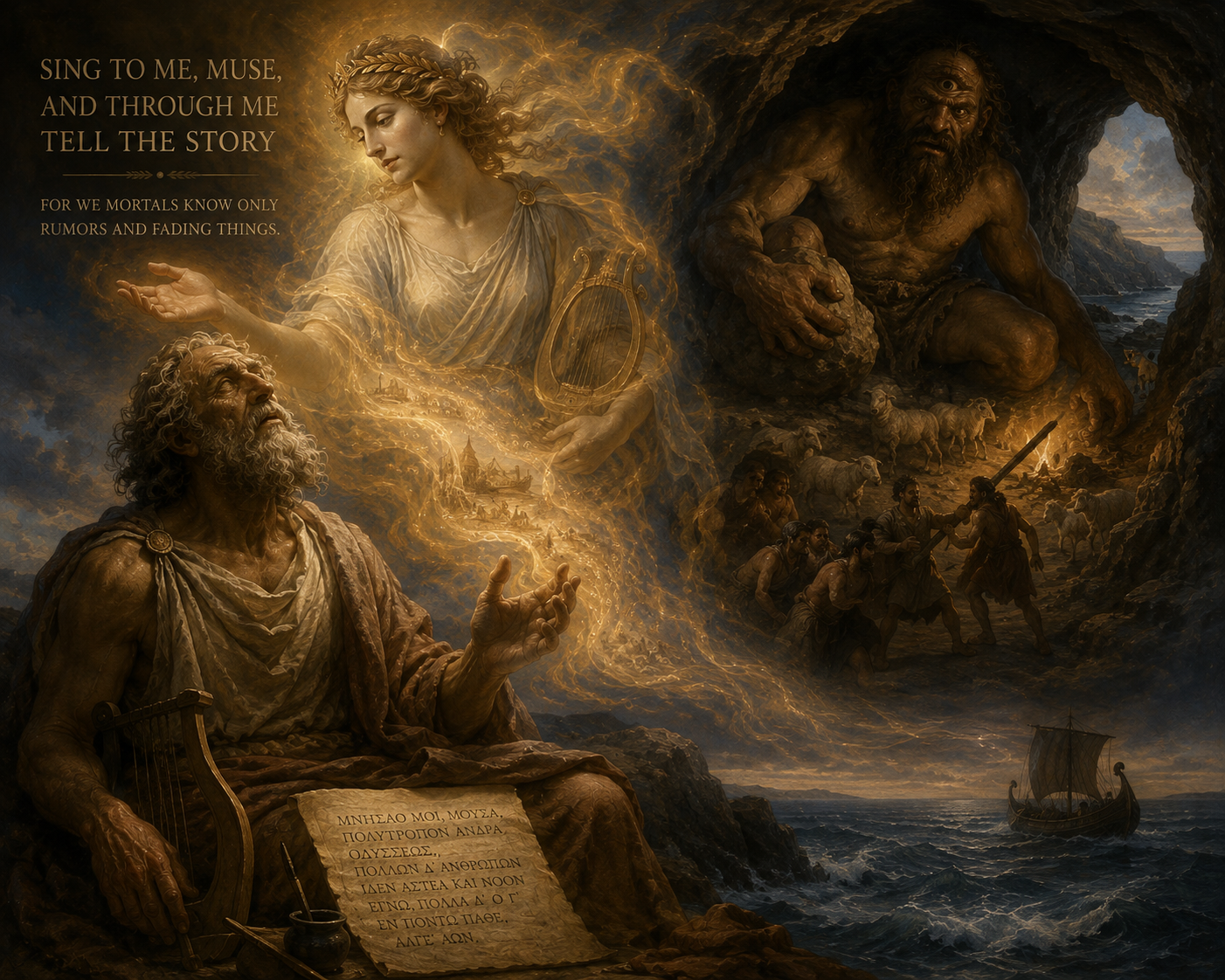
Sing To Me Muse…
by Gabrial Stevens
26 September 2026
In reviewing Christopher Nolan’s The Odyssey, I do not intend to offer a sweeping overview of the many alterations Nolan has made to the Homeric epic1. After all, in its protean form, The Odyssey was sung by bards in an oral tradition, which meant that the story was always being made anew. However, what happens when a director embarks upon the voyage of The Odyssey without invoking the Muses? Should divinely inspired poetry be turned into a motion picture? And when does an interpretation sever rather than serve its relationship to the source material? To answer some of these questions, I will focus upon a singular omission in Nolan’s adaptation: the moment Odysseus tricks the Cyclops into believing his name is ‘Nobody’. In the spirit of the bardic tradition, in which no one person holds the definitive meaning of a text, may this essay sit as one amongst many interpretations of the film. A fragment of the whole that offers a glimpse into the spellbinding magic of the oral tradition of Homeric poetry.
Nolan’s The Odyssey is shot entirely on 70mm IMAX cameras. Spools of inked celluloid, each individual frame spanning fifteen perforated holes, are cut and pasted together to create a fluid and unbroken sequence of images. Three minutes of film requires approximately one thousand feet (about three hundred and thirty-four feet per minute) of physical 70mm film stock. In this way, cinema is its own type of magic. A kaleidoscopic spectacle that entices the eye into a world of moving colour. Landscapes, people and mythical monsters loom above us. Like all great storytellers, Nolan places his audience into the middle of an ongoing story. He achieves this with sweeping shots of the ocean and a cluster of islands where panthers stalk the foothills; Laestrygonians tower above Odysseus’s crew and Troy is engulfed in flames. However, with the opening title card of the film, Nolan makes a significant departure from the Homeric tradition by stating that The Odyssey is set during ‘a time of apparent magic.’ ‘Apparent’ is a deeply suspicious word. A word that casts a shadow of doubt over the great wisdom traditions of the past. As Dr Martin Lings comments in Ancient Beliefs and Modern Superstitions, ‘A superstition is something which continues to prevail without being understood’ (Lings, 1991 p.26). As I shall go on to explore, to appreciate the greatness of The Odyssey, we must first come to understand the spellbinding magic of Homer’s poetry and how the hero’s embodiment of language is a microcosm of the poem’s macrocosmic brilliance. Like a scion grafted to a rootstock, it is the point of contact that connects an interpretation to the riches of its imaginal heritage. If this connection is severed, as Nolan seems intent on doing, the tradition is broken. Rather than a mythology, in which each image speaks beyond their literal selves to partake in a larger constellation of symbolic interpretation, we enter into a ‘chaos of borrowings’ (Lings, 1993 p.15). In Nolan’s film, Odysseus is no longer a hero celebrated for his glorious deeds during the Trojan War. He is a man wracked with guilt. Gods are replaced by the elemental forces of the wind and sea. Uncoupled from his speech, Odysseus falls silent. A pervading sense of amnesia spreads through the absent limbs of dialogue. Nóstos2, which fills the Homeric universe and is the invisible life force of the hero, is warped by a psychologised notion of self. Instead of growing from the substrate of the source material, the film begins to overlay its own vision on top of the poem. Stripped of the strangeness of the past, we enter into the familiarity of the present. In its wake, we get a film that is mesmeric in both scale and production, but ultimately hollow. Unfortunately, as Nolan suggests by placing ‘apparent’ before the unfolding of events, the magic here is of appearances only.
If we return to the roots of Homeric epic, The Odyssey was sung by rhapsodes3. Each version of the telling began with an invocation to the Muses: ‘Launch out on his story, Muse, daughter of Zeus, start from where you will — sing for our time too’ (Fagles, 1996 p.77). Through divine inspiration, each version of the tale was stitched together into a long line of songs. As Ivan Illich comments in his work In the Vineyard of the Text, the Greeks believed rhapsodes made: ‘One man hang down from the other, like the links of the iron chain that hangs from that stone in the dome of Heraklea that Empedokles calls ‘the magnet’’ (Illich, 1996 pp.40-41). From a feast in an aristocratic banquet hall to a four-day telling at the Panathenaia, the song travelled from a situated self up the kinetic chain to the realm of the gods. The reverberations of the lyre and the rhythmic lines of dactylic hexameter subsumed the oratorical emphasis of individual elocution into the language of epic; the muses taking away the mind of the singer so that each retelling may become a conduit of the divine. Furthermore, the dactylic hexameter of six metric units rises and falls like waves. A rhapsodic undulation that plunges the poem into a ceaseless unfolding of change. In this light, the sea in the poem is not only the backdrop to Odysseus’s wanderings, but the very fabric of the journey itself. All one hears and sees expands the self ever outward. Horizontality is enriched by the verticality of the tale’s divine origins. In the existence-tissue of epea pteroenta, the ‘winged words’ of Homeric poetry, where does the hero’s identity begin and end? Each moment, pregnant with transformation, asks its audience to participate with the entirety of their being. However, when the spellbinding rhythm of poetry is swept up in the grandiosity of explosions and magic tricks of an action-packed film, the wandering pilgrim of the reader or listener becomes a tourist of an exotic world that can be marvelled at but not lived in. A sensory deprivation in which all nuance is drowned out as the plot continues unabated. As far back as the 12th century, Bernard of Clairvaux warned people of the dangers of illuminations in prayer books when they are no longer addressing the reader, by speaking to them about the littera that is being read, but conceived of as parallel to the narration — a literature in its own right. As Illich comments, ‘he [Bernard of Clairvaux] insists that flamboyant ornaments addressing the senses foster a sensual devotion or piety in people whose spirit has not been awakened.’ (Illich, 1996 p.111). What began as nonverbal realities for the same revelation that the words are transmitting soon becomes an abstraction. Cut off from the living, numinous and translucent realm of the imaginal, images are imprisoned in an echo chamber of their own values.
In order to anchor this idea, let us look at a singular omission within Nolan’s adaptation. In Homer’s The Odyssey, when Odysseus tells the Cyclops his name, he says his name is ‘Nobody’. Later that same night, as they blind the Cyclops’s eye with the pointed tip of a wooden stake, the Cyclops cries out in despair: ‘Nobody, friends… Nobody’s killing me now by fraud and not by force’ (Fagles, 1996 p.224). Under this guise, the wily Odysseus and his men escape. However, Odysseus cannot resist one final act of hubris. On board his ship, he shouts back: ‘If any man on the face of the earth should ask you who blinded you, shamed you so — say Odysseus, raider of cities, he gouged out your eye’ (Fagles, 1996 p.227). In Nolan’s rendition, this final retort is replaced by an action. As he flees, Odysseus turns and shoots an arrow. Both variations elicit the rage of the Cyclops’s father (Poseidon), and a journey that could have taken a few weeks becomes a ten-year epic. Nevertheless, by placing the turning point on an action, rather than words, a certain vigilance is lost. In Greek, outis ‘nobody’ sounds very close to mêtis, ‘wisdom’, ‘skill’ or ‘cunning intelligence’, when it is placed within a conditional statement. The Greek grammar forces the negative pronoun to change outis into mē tis ‘no one’4. Alarmed, the neighbouring Cyclops’s speech morphs from: ‘If nobody is harming you’ into ‘If cunning intelligence is harming you…’ then it must be a plague sent by Zeus. Within this tightly woven structure, Odysseus’s epithet, polumêtis: ‘much-witted’, ‘of many counsels’ or ‘stratagems’ is revealed. The Cyclopes unintentionally announce Odysseus’s defining trait as the very thing that has led to their downfall. Similarly, Penelope, who waits for Odysseus’s homecoming, delays the suitors who wish to marry her by weaving a shroud for Laertes (Odysseus’s father) during the day and at night, unravelling it. The process of weaving and unweaving delays the suitors from asking for her hand in marriage. When Penelope’s ulterior motives are finally exposed, she says she could not think of another ‘deft way out’ (Fagles, 1996 p.177). The word translated here is mêtis. Penelope and Odysseus are cut from the same cloth. This image is further enriched when we dwell upon the language used to describe the cloth that Penelope ravels and unravels. In some versions of the text, it is described as marmareēn or porphyreēn. According to Nicolson, marmareos can mean ‘gleaming or twinkling like sunlit, wind-stirred water; porphyreos heaving, or surging like a sea swell…’ (Nicolson, 2015 p.196). From a noun, the cloth morphs into a verb. To the suitors, the wind-stirred waters of the fabric reflect a false reality. This is the ‘shroud’ that hides, covers, disguises and obscures. But to Odysseus, the cloth twinkles with opportunity. It is the never-surfeit sea that will eventually carry him back to the shores of Ithaca.
It is important to note that in Homer’s epic, it is Odysseus himself, ‘the great teller of tales’ (Fagles, 1996 p.211), who recounts the story of the Cyclops to the Phaeacians. Partaking in the vast, generations-old oral tradition of his own story, his past deeds are examined through the alchemical crucible of his own speech. If Odysseus was able to quell his fighting spirit and remain a ‘nobody’, his men would have been able to safely return home. However, in a singular act of pride, the multiplicity of his cunning is turned into the singularity of a name. A knowable fact. In turn, he is greatly punished by Poseidon. However, by enshrining his mistake in song, we enter into a recursive dialogue with the past. When Odysseus says he is ‘Nobody’, his intelligence intuits a reckoning that will befall his future self. Independent of his desires for kleos — the glory and immortal fame one earns through great and daring deeds — he must first become a ‘no one’. Stripped of everything he has, he returns to Ithaca as a beggar. And yet, by recounting the events of his homecoming to the Phaeacians, Odysseus’s desire for kleos and the reality of having to become ‘no one’ are not held as irreconcilable opposites but as a continuum. In retelling the events of past deeds, Odysseus weaves himself back into his own story. In turn, the process of dismemberment becomes an act of remembrance. When we uncouple Odysseus from this tradition, we lose the verticality of his character. What we are left with is the image of a man shooting an arrow back at the Cyclops. And whilst the image of the bow has its own depth — the bow being a recurrent motif5 within the film — the direct and singular shot of the arrow risks collapsing the multiplicity at the heart of the poem. However, if we return to the act of storytelling, we find Odysseus is held within an ecology of selves. Prior to launching into his own story, we hear about the fall of Troy through the voice of Demodocus. A bard whom the Muses have taught the ‘paths of song’ (Fagles, 1996 p.207). In this constant act of doubling, Homer’s poetry lets us participate in an infancy of beginnings. By calling upon the Muses, daughters of Mnemosyne (Memory), divinity presses itself into the mortal frame of the hero. A sublimation of self in which our own dying becomes the revelation of life.
In conclusion, the beauty of The Odyssey lies in the polyvalence of Homer’s poetry; the close-knit unity of Odysseus’s character reflected in the elaborate and tightly woven structure of myth. A synthesis of such complexity that only through its total affect can we glimpse the superlative quality of Homer’s divinely inspired vision. To be a hero is an act of remembrance. However, if the verticality of recollection is lost and the hero is cut off from the divine inspiration of the gods, what stands in its hollowed place? Has Nolan unwittingly made the same mistake as Odysseus when he tells the Cyclops his name? The role of the rhapsodes who recall the cavernous workrooms of memory — Penelope weaving and unweaving the shroud of Laertes; Helen of Troy stitching a double-folded crimson cloak that portrays the struggles of the Trojan War; and Circe who sings as she glides ‘back and forth at her great immortal loom’ (Fagles, 1996 p.237) — now falls into the hands of a film crew and the singular vision of a director. Histós, the ancient Greek word that carries the double meaning of a vertical beam of a loom and the mast of a ship, is superseded by 70mm IMAX film passing through the horizontal drums of a projector.
Notes
- Emily Wilson’s critique of the film in the London Review of Books, titled: ‘An Uncomplicated Man’ provides a detailed account of Nolan’s departure from Homer’s vision and its repercussions.
- The song of homecoming.
- Rhapsody comes from the Greek, rhaptein ‘to stitch’ and ōidē, ‘song or ode’.
- The phrase mē tis, ‘no one’ and the noun mêtis are absolute homophones in spoken Ancient Greek.
- An image that is established early on as connoting Odysseus’s unique physical prowess and kingship, as he is the only one strong enough to string it.
Refrences
- Fagles, R., (trans). (1996). The Odyssey. London: Penguin Books.
- Illich, I., (1996). In the Vineyard of the Text: A Commentary to Hugh’s Didascalicon. Chicago: The University of Chicago Press.
- Lings, M., (1991). Ancient Beliefs and Modern Superstitions. Cambridge: Quinta Essentia.
- Lings, M., (1993). What is Sufism?. Cambridge: The Islamic Texts Society
- Nicolson, A., (2015). The Mighty Dead: Why Homer Matters. London: William Collins.
- Nolan, C., (2026). The Odyssey. Los Angeles: Universal Pictures.